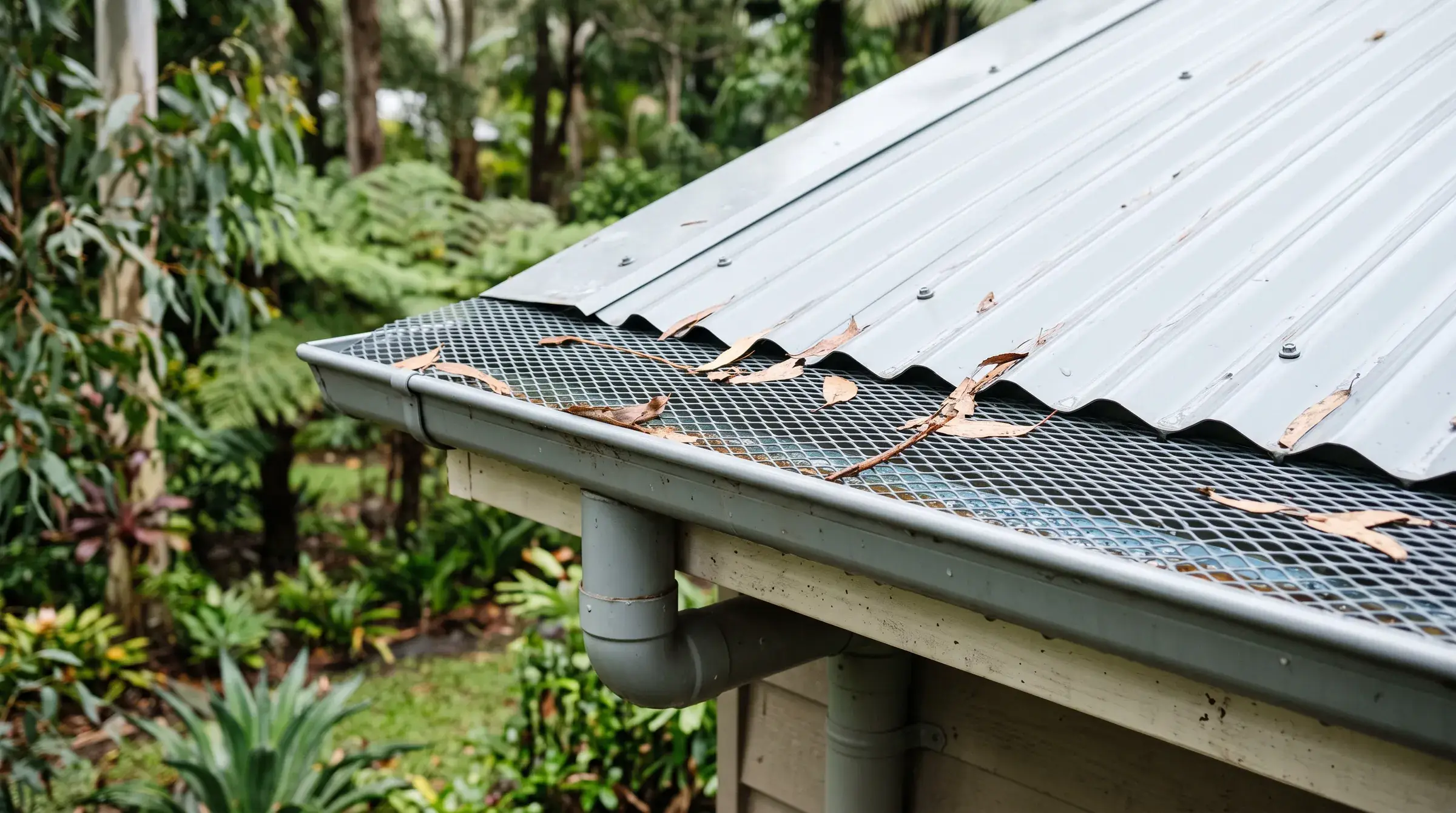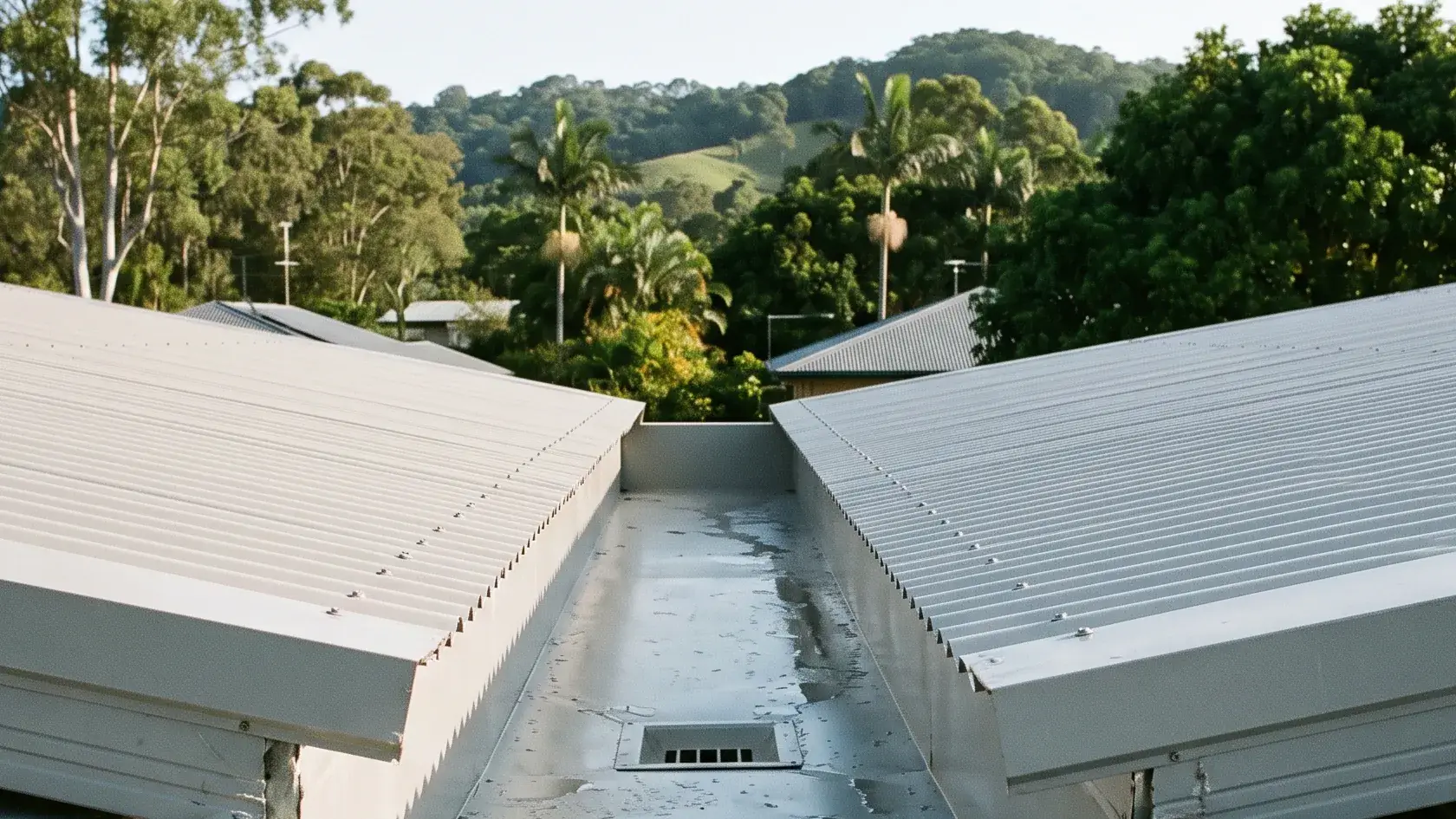
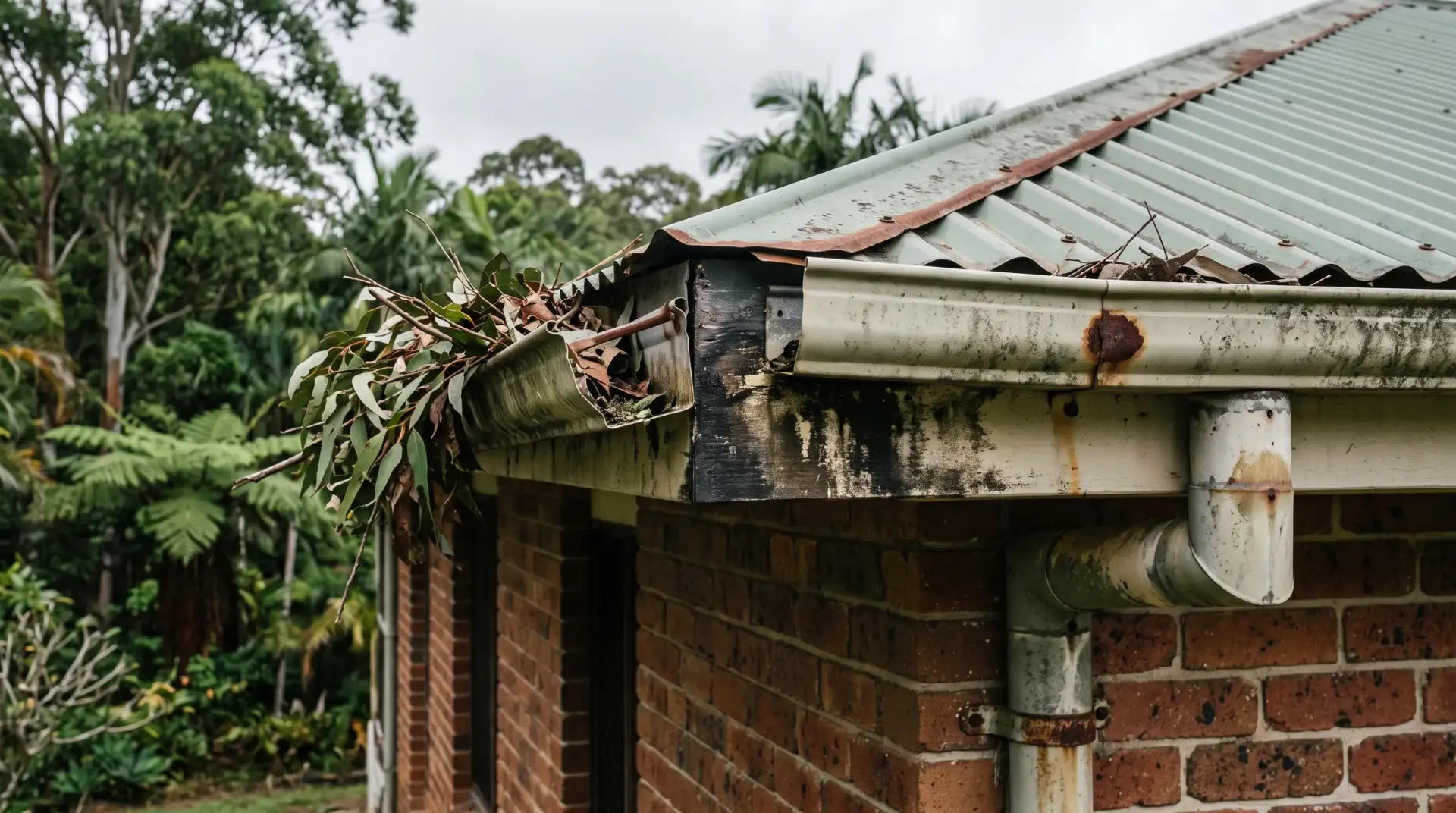
Ricky Jenner Roofing handles gutter repairs, downpipes and fascia replacement across the Northern Rivers, and gutter damage almost always starts as something you can see from the ground. Sagging runs, rust at the joints, drips, stained eaves and plants in the gutter all mean water is going somewhere it should not. Caught early, most of it is a repair rather than a replacement.
What are the signs of gutter damage?
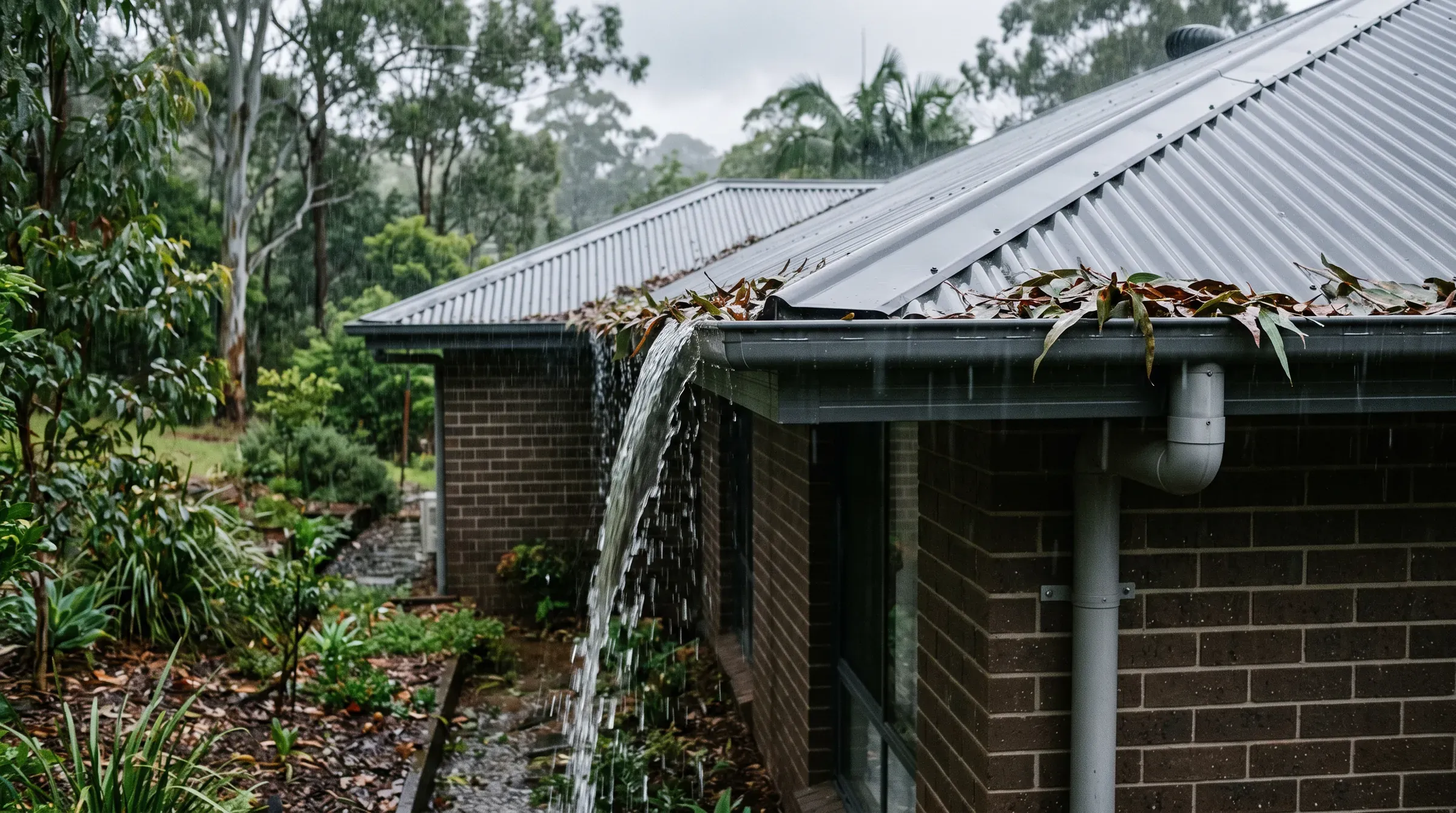
Guttering fails quietly: a sagging bracket, a rusted join, then one storm sends water over the back and into the eaves. Walk around the house on a dry day and again in steady rain, and look for these.
- Sagging or pulling away. A gutter needs a steady fall to each downpipe. The NCC sets a minimum fall of 1:500 for eaves gutters, with brackets no more than 1.2 m apart. A line that dips, a gap opening at the fascia, or water still sitting a day after rain all mean the fall has gone.
- Rust, holes and leaking joints. Joints, corners and stop ends usually go first, because water and wet leaves sit there longest. Look for brown streaks under a joint, drips from the underside in rain, and bubbling paint along the lip.
- Stains on the fascia or eaves. Dark streaks, mould spots, peeling paint or tide marks on the wall mean water has been escaping for months.
- Plants and silt. Grass or seedlings growing out of the gutter keep the steel damp long after the rain stops, and a gutter that stays wet corrodes faster.
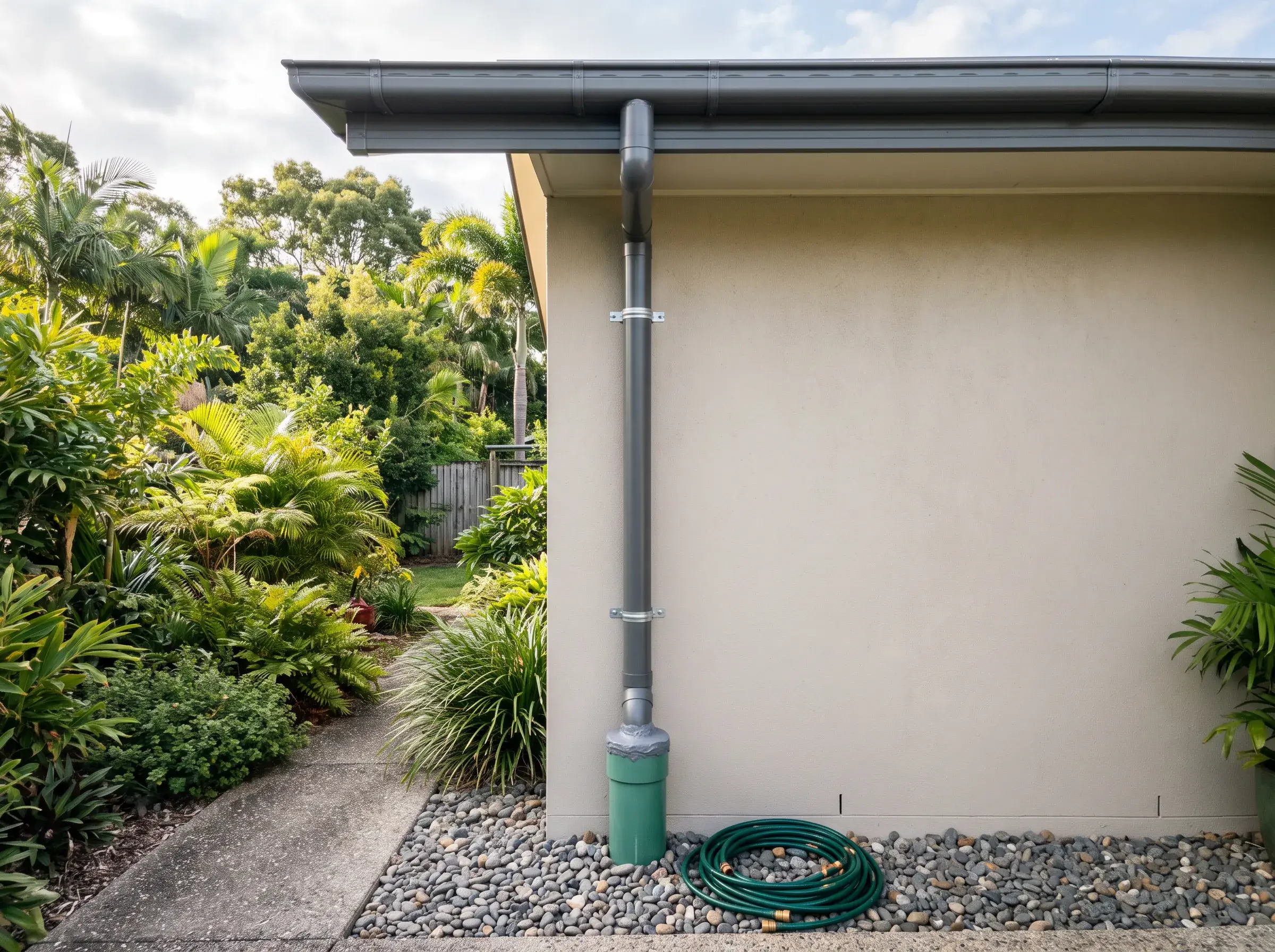
- Downpipe trouble. A downpipe that spills at the top, leaks at a joint or leaves the ground soggy at its base is usually blocked, or its stormwater connection has failed.
What speeds up gutter damage?
Water over the back. In a very heavy downpour some water over the front of a gutter is expected. The NCC designs eaves gutters for a storm with a 5% annual chance, and requires anything beyond that to overflow away from the building. Water over the back means a blocked outlet, a gutter that has lost its fall, or one fitted without a safe overflow path. Our guide to overflowing gutters explains how to tell which.
Copper and lead run-off. BlueScope’s flashing materials bulletin (TB-8) warns that water running off copper, such as a hot water system overflow, and off lead flashings corrodes Colorbond® and Zincalume® steel. Rust directly below a copper pipe is the giveaway.
Salt near the coast. Salt builds up on the parts of the gutter that rain never washes. BlueScope’s maintenance bulletin (TB-4) recommends washing the undersides of gutters and fascias at least every six months, or every three months where salt spray is common. In Ballina, Lennox Head and Byron Bay, a regular rinse with the hose is the cheapest thing you can do for your gutters.
Fascia and eaves: the damage behind the gutter
The fascia is the board the gutter hangs on. When water gets behind the gutter, the fascia takes it first. Timber softens and rots, brackets lose their grip and the gutter sags further. From there, water runs into the eave lining and sometimes into the top of the wall.

Fascia replacement. A short rotten section of timber can be cut out and replaced. Where rot runs the length of the board, the fascia is usually replaced with the gutter, because the gutter has to come off anyway. Steel fascia made from Colorbond steel is an alternative that does not need painting. Where old gutters have taken the fascia with them, we repair or replace it in the same job.
Eaves repair. A stained or sagging eave lining is a symptom. Stop the water first by fixing the gutter, the fall or the roof leak. Then the lining can be replaced and painted without the stain coming back.
Repair or replace?
Most gutter problems fall into one of these patterns.
| What you find | Usually the fix |
|---|---|
| One leaking joint or corner | Repair: re-seal or replace that section |
| Loose or rusted brackets, gutter still sound | Repair: re-fix the brackets and restore the fall |
| Rust holes in several places | Replace the run |
| Sagging because the gutter itself is bent | Replace the section or the run |
| Rotten fascia along the run | Replace the fascia and gutter together |
| Spilling along the whole run in heavy rain | Check the size and downpipes: often a bigger gutter or an extra downpipe |
If you are replacing, fix whatever caused the damage at the same time. That might mean an extra downpipe, a proper fall, or gutter guards on a leafy block. Our gutter replacement work covers Colorbond gutters, downpipes and fascia, colour-matched to your roof. If stains are showing up on a ceiling rather than the eaves, the problem may be the roof itself, and roof repairs are the place to start.
Is gutter repair a DIY job?
Scooping leaves out of a single-storey gutter is something many owners do themselves. Anything more, on a ladder or on the roof, carries a real risk of a fall. In NSW, fixing, installing, repairing and maintaining guttering, downpipes and roof flashings is roof plumbing work, and a contractor licence is needed when the job is worth more than $5,000 in labour and materials.

Our business licence is NSW contractor licence 389777C, which includes the Roof Plumber class. Every job starts with an on-site look and a free itemised quote.
COLORBOND® and ZINCALUME® are registered trade marks of BlueScope Steel Limited.
Common questions
How do I know if my gutters need replacing?
Replace rather than repair when the damage is spread along the run. That means rust holes or thin metal in several places, joints leaking at more than one spot, sections sagging because the gutter itself has bent, or a gutter too small for the roof above it. One leaking joint, a loose bracket or a rusted stop end can usually be fixed on its own.
Can a rotten fascia be repaired?
A short rotten section of timber fascia can be cut out and a new length joined in, as long as the rafter ends behind it are sound. If the rot runs along the board, or the gutter brackets no longer hold, the fascia is usually replaced along with the gutter, either in new timber or with a steel fascia system that does not need painting.
What causes stains on eaves?
Stains on eave linings are nearly always water. The usual causes are a gutter overflowing at the back, a leaking joint or corner, a gutter that has lost its fall so water sits against the fascia, or a roof leak running down to the eave. Mould spots and flaking paint follow. Find and fix the water source before replacing or repainting the lining.
How long do Colorbond gutters last?
There is no single number. BlueScope sets its warranty periods for Colorbond steel by how the product is used and where the building is, and real life depends on salt exposure, how long the gutter stays wet and what drains into it. Gutters last longer when leaves are kept out, undersides are washed near the coast, and copper or lead run-off never reaches them.